Friday, October 29, 2021

The 75th Anniversary of The War of the Worlds, Or: How Orson Welles Scared A Nation

Originally published: October 30, 2013
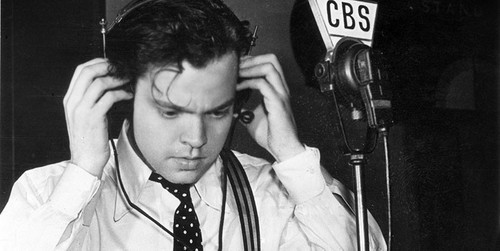

TODAY marks the 75th anniversary of Orson Welles and the Mercury Theater on the Air’s notorious radio broadcast 'The War of the Worlds'. This first adaptation of H.G. Wells’ seminal science-fiction novel took the form of a series of shocking news bulletins and convinced thousands of Americans that an invasion from Mars was taking place. 

Nearly a century later the extent of the panic is still subject to discussion. Many believe the printed press of the time exaggerated their claim of mass hysteria to cast shade at their new radio rivals. Using the ‘War of the Worlds’ incident as an opportunity to point out the dangers of radio. 

The eve of Halloween

In reality there were a number of people who did panic. And who can blame them? American radio listeners weren’t exactly in the calmest state of mind when Welles went on the air. With growing tensions overseas, many relied on radio for much of their information on world affairs. These factors are said to have contributed greatly to the public’s reaction. 

As an alien invasion story ‘The War of the Worlds’ was also the first of its kind. Published in 1898, it was one of the novels that earned H.G. Wells his reputation as a writer of speculative fiction. Since the radio broadcast the story has been adapted several times: George Pal released his version in 1953 followed by Steven Spielberg in 2005. Jeff Wayne even made a musical version in the late ’70s. 

''We interrupt this program...''

Even after 75 years the broadcast is surprisingly convincing. As a holiday offering the ‘The War of the Worlds’ began innocently enough. With Orson Welles describing the Martians’ motivations: Their planet was dying and so they conspired to colonize our fertile blue dot. After this prologue the listeners were treated to some ballroom music, regular programming at that time.* 

 It didn’t take long for the ‘original’ programming to be interrupted by a news flash. It was the first in a series of increasingly bizarre news reports. However it wasn’t until a reporter covered the Martian arrival firsthand that things got really freaky. The reporter described squid-like beings crawling from the spacecraft. Moments later listeners heard bloodcurdling screams, as the crowd (including our dedicated reporter) were set on fire by the Martian weapons. 

‘’I don’t want to die alone!’’ 

After the broadcast revealed the Martians and their nefarious intentions people took to their phones. In San Fransisco a man called the police department to ask if he could volunteer to fight the men from Mars. A woman in Boston claimed she’d seen flames above the treetops. She ran from house to house, warning her neighbours of the approaching danger. In Missouri a man, clothed in nothing but a bathrobe, knocked on his neighbour’s door saying he didn’t want to die alone. 

Panic grew when the broadcast described the invaders’ giant war machines. Many New Yorkers got in their cars and attempted to flee the city. A man in Pittsburgh saved his wife from committing suicide. She claimed she’d rather take her own life than be slaughtered by Martians. 

 The people of Newark took to the streets when the broadcast warned them of poisonous gas coming their way. Many were seen holding handkerchiefs against their mouths, as not to breath in the poison. A woman in Minneapolis sought refuge in a church. She frightened churchgoers by announcing the end of the world. On the night of October 30th 1938 ‘The War of the Worlds’ became the biggest Halloween prank anyone had ever pulled. 

The beginning of a career 

At first Orson Welles was taken aback by the public’s reaction to his radio drama. Years later he confessed that he wasn’t as innocent as he appeared. He referred to ‘The War of the Worlds’ as his assault on the credibility of radio. He was fed up with the way people took everything that came over the radio as fact. The broadcast was his way of telling people to think for themselves. 

For some listeners the broadcast did just that. They became suspicious of many events reported over radio. Some even doubted early reports of a Japanese attack on Pearl Harbor. Welles himself wasn’t left empty-handed either. ‘The War of the Worlds’ earned him the attention of Hollywood, which led to his highly regarded directorial debut ‘Citizen Kane’. It was the beginning of a legendary career.† 

Notes: 

*Bernard Herrmann was responsible for the music in the broadcast. Herrmann went on to become one of a most famous film composer. Scoring such classics as ‘Citizen Kane’, ‘The Day The Earth Stood Still’ and ‘Psycho’. 

†In 1940 Orson Welles and H.G. Wells met for a radio interview. During this conversation the elderly writer asked Orson about his upcoming film ‘Citizen Kane’. Orson thanked him for the opportunity to plug his new project. He explained it was a new kind of motion picture, featuring new methods of visual storytelling. H.G. Wells responded with this funny little line: ‘’If I don’t misunderstand you completely, I understand there will be a lot of jolly good new noises in it.’’

Wednesday, October 16, 2013

Gravity Review

'Gravity' is a masterpiece. An awe-inspiring mix of action, horror and humanity. It has been seven years since Alfonso Cuarón gave us 'Children of Men' but it was worth the wait. There's never been any movie quite like 'Gravity'. The imagery presented in this film is simply mind-boggling. It's an amazing accomplishment.


However all that craftmanship would've been for naught, had the story not worked on a basic human level. Astronauts Stone (Sandra Bullock) and Kowalski (George Clooney) are on a shuttle mission. They are on a routine spacewalk when things go terribly wrong. In a matter of seconds their shuttle is destroyed and they find themselves adrift in space. 

From then on it's a story of survival. Through the magice of storytelling, we experience Stone's ordeal as if we're there with her. The film works like clockwork. The timing of action and emotional beats is impeccable. It's been a long time since I've seen such economical storytelling in a big budget feature. It's a refreshing surprise.

It's apparent that Alfonso Cuarón strived to make 'Gravity' as realistic as possible. In the opening sequence, people and objects are seen gliding effortlessly through the zero-g environment. Earth fills up the screen behind them. It's a beautiful moment. This tranquility lasts until the debris field moves into view. The effects of the debris hitting the spacestation are frighteningly violent. 

Cuarón overcomes the scientific impossibility of sound in space by employing Steven Price's effective musical score. It's a compelling soundtrack that combines beauty and dissonance. That is true for the movie as a whole. 'Gravity' shows the us the wonder and the insurmountable risks that come with space exploration. 

Still, it's the intimacy of the story that makes it so tangible. 'Gravity' is a small movie, set against a vast backdrop. We experience Stone's fight for survival as if it were our very own. The film owes its emotional power to Bullock's honest performance. The transformation she goes through is wonderful in its simplicity and the actress pulls it off brilliantly. 

'Gravity' is a work of pure artistic craftmanship. Seldom have I seen a film that hits home like this one does. Alfonso Cuarón and his cast and crew have created a film that is as close to perfection as you can get. This is filmmaking at its finest. That's why 'Gravity' is the most viscerally engaging film I've seen in a long time. It really is a masterpiece.  

Saturday, October 12, 2013

Machete Kills Review

'Machete' began life as a fake trailer attached to the film 'Grindhouse'; a project spearheaded by Quentin Tarantino and Robert Rodriguez. The trailer starred Danny Trejo as a pissed-off Mexican mercenary. Eventually Rodriguez took it upon himself to expand upon the trailer and bring 'Machete' to the big screen. The result was a mildly entertaining action film that tried hard to be fun but failed miserably.


You'd think Rodriguez and Trejo would leave 'Machete' well enough alone. Unfortunately they stuck a teaser for a sequel on the film's ass end. And because they are men of their word, we're treated to a sequel that comes close the being the movie 'Machete' tried to be.

'Machete Kills' is over the top, simplistic, awful, violent, misogynistic and fueled by testosterone. Danny Trejo is still the worst leading man I haver ever layed eyes on. He has no character or charisma, all he has is a face. And it's not even a pretty one. Really, there are burn victims with prettier faces than Danny Trejo.

I didn't expect 'Machete Kills' to be good. But it's a testament to awful filmmaking that Trejo has zero impact his own story. His character only rarely makes a choice that influences the direction of the story. Most of the time he's just along for the ride, surrounded by people who are a lot more interesting than him. Both of these films prove that it's hard to make good bad movie.

Because that's what they were trying to do, make a good bad movie. It's terribly tricky thing to do, because if you do it the wrong way you end up with a bad bad movie. That's what happened to 'Machete'. Luckily this sequel has a few aces up it's sleave. Those aces are Demian Bichir, Antonia Banderas, William Sadler, Cuba Gooding Jr., Carlos Estevez and Mel Gibson.

I don't know how many family members Rodriguez had to kidnap in order get these actors in this movie but it's worth the effort. They're all visibly enjoying themselves. The one who sticks out, however, is Mel Gibson. He is great as the film's big bad.* You could write a whole book (okay, maybe five pages) about this guy's ode to James Bond villains. But even the shiniest of stars can't hide the awful turd that is 'Machete Kills'. Still, I hope against hope that 'Machete Kills Again... In Space' will be the masterpiece we deserve.

*It's going to be hard for Leonardo DiCaprio to top Mel Gibson in the next movie. 

Tuesday, September 3, 2013

Kick-Ass 2 Review

Jeff Wadlow's 'Kick-Ass 2' is a shallow sequel. It's one of those follow-ups that doesn't understand what made the original film work. Becoming an occasionally enjoyable knock-off while Matthew Vaughn's 'Kick-Ass' was an absurdly entertaining mix of violence and comedy. On top of that, this sequel is so mean spirited it makes you feel downright dirty.


All the big elements are back. Aaron Taylor-Johnson returns as the geeky superhero Kick-Ass. Chloë Moretz reignites controversy as Hit Girl. And Christoper Mintz-Plasse takes over from Mark Strong as the film's main baddie. The biggest new name must be Jim Carrey. Who plays a religious nutcase known as Colonel Stars & Stripes. Carrey is the one of the film's sole highlights.

Much like the original there's lots of swearing and cussing. Of course there's also an unhealthy amount of violence, but if you're going to see a movie called 'Kick-Ass 2' you can't really complain about that. You can complain about the overall quality. This flick feels like it should've gone straight to DVD. It's simply doesn't operate on the same level as Vaughn's original.

I'm not arguing that the first 'Kick-Ass' was some kind of masterpiece. However it was funny, well-paced and action packed. It had a huge amount of wit and (semi-)intelligence. All of which 'Kick-Ass 2' isn't able to match. The first film had Nicholas Cage in a role that didn't feel like stunt casting. Cage was a perfect fit for an insane superhero. Here we get Jim Carry, whose greatness is wasted on a bit part. It's just a missed opportunity.

The only real exception to the rule is Chloë Moretz. Who jumps at the chance to explore Hit Girl's twisted psyche. Along with Moretz we discover that the apple didn't fall from the tree. Hit Girl (aka Mindy) is just as bat-shit insane as her old man. Stubbornly believing in the virtues of vigilantism even though everything that happens to her and her loved ones should make her think twice.

So while 'Kick-Ass' seemed aware of its skewed morality, this sequel isn't. In fact, the filmmakers seem to revel in being as crass and violent as possible. There's a handful of moments that echo the original's sense of fun but those aren't enough for 'Kick-Ass 2' to redeem itself. As it stands, this sequel is barely worth your time. You're better off watching Matthew Vaughn's original again instead. 

Saturday, August 10, 2013

Elysium Review

In 2009 the South-African director Neil Blomkamp surprised audiences with 'District 9'. A landmark film in the science-fiction genre. Now it's four years later and again Blomkamp has crafted a futuristic action movie with a brain. The film is called 'Elysium' and it's a perfect companion piece for 'District 9'. 


'Elysium' paints a bleak future. You might think we have it bad right now but boy, wait until you get to 2154. Everywhere you look there's garbage and people living in squalor. There are law enforcing robots staring at you from every corner. And if you want a job you can go work at the factory. It's dangerous and monotonous but it does keep you off the street.

Your boss, though. He got a far better deal than you. That wealthy bastard gets to live on Elysium; a space station orbiting Earth. He's not alone up there. Nope, every rich son a bee lives in that artificial piece of heaven. It's awesome. There's no hunger or sickness and you'll never have to do any physical work ever! Obviously, the people who live on Earth feel a bit miffed by the fact they aren't allowed to live on Elysium.

Max is miffed too. Especially because he's only got five days to live after an accident at work. On Elysium he'd be cured in a second but on Earth he's a goner. So what would you do? Get you're irradiated ass to Elysium, of course! It isn't going to be an easy trip. For starters, the rich bastards don't take kindly to people coming for their home. Then there's the ruthless way they choose to do away with the people who try.

Matt Damon is Max. He's got the role of everyman down pat. It doesn't matter if he's working at a factory or kicking ass, he's entirely believable. Jodie Foster is rich bitch numero uno. She's not that threatening on her own but she does have a dog that bites. That dog is the ruthless Agent Kruger. It's a massively creepy role that should make Sharlto Copley into a household name (even though it's pretty difficult to pronounce). 

Neill Blomkamp has created an intelligent bit of sci-fi. There's enough action to satisfy your average moviegoer but it also provides some healthy food for thought. In many ways Blomkamp's films evoke the work of Paul Verhoeven. Both are masters at infusing their action films with a wealth of ideas. Like Verhoeven, Blomkamp also has a fondness for ickyness. The violence is graphic and disturbing but it's never glorified. 

On the contrary. Much like in 'District 9' the weapons are so brutally effective that using them could be considered cowardly. People are dismembered, decapitated and blown apart with only a slight squeeze of the trigger. But for all the violence and action, 'Elysium' never quite forgets what it's about. In its heart it's a movie about the ever growing divide between rich and poor. These days it is rare for a blockbuster to have not just a heart but a brain. And like any great science-fiction story, 'Elysium' is a compelling reflection on the human condition. 

Thursday, July 25, 2013

The Wolverine Review

It was to be expected. Nothing can stop Hugh Jackman from returning as the bad-tempered mutant John Logan. Not even a piece of trash like 'X-Men Origins: Wolverine'. His second solo outing fares better. 'The Wolverine' is a likeable movie. James Mangold provides us with a fun ride with ample amounts of action and even some character work.


'The Wolverine' opens with a bang. Actually, it opens with second biggest bang in history; the detonation of a nuclear bomb at Nagasaki in 1945. Naturally, none other than Wolverine is there to witness the event as a prisoner of war. In an act of bravery he saves a Japanese officer from a fiery fate. And unbeknownst to Logan, young Yashida grows up to be the most powerful man in Japan.

So while Yashida lives it up, Wolverine lives like a vagabond. He has sworn off his violent ways because of his hand in Jean Grey's death. But he's haunted by visions of his former love none the same. But as we all know, a pacifistic Wolverine is boring so the filmmakers bring in Yukio (Rila Fukushima). She's also a mutant, gifted with the depressing power to foresee people's deaths. Her employer wishes to strike a deal with Logan. One that involves giving up his immortality. 

Obviously the employer turns out to be Yashida. Who, rather than dying of old age like a regular Joe, wants to extend his life by transferring Logan's healing ability to himself. The moment John refuses, shit hits the fan. Our beloved mutant is cast into a web of lies and once again he's forced to become The Wolverine. What follows is a fun but ultimately unremarkable piece of summer entertainment. 

Hugh Jackman is a permanent fixture in 'X-Men' universe, playing the character of Wolverine for sixth time. (He'll also be a part of next year's 'Days of Future Past') He's also the only one to get his own movie series. A strange thing because Wolverine is arguably the least interesting character in the franchise. Still, Jackman's charisma is there in abundance but it's all becoming a bit stale.

That's basically what the entire film feels like. There's nothing entirely bad about it but there isn't anything really good either. It's a generic movie. One that neither impresses nor offends. As hard as I try, I can find no fault with it. If you're looking for a good time, you can't go wrong with 'The Wolverine'. It's quality entertainment. But in all fairness, you'll forget you even saw it the moment you leave the theatre. 

Thursday, July 18, 2013

Pacific Rim Review

Every once in a while a movie comes along that raises the bar. That works on a scale that we've never seen before. The original 'King Kong' is one of those movies, 'Star Wars' is another. These are films that opened up lush new worlds and introduced us to legendary, yet human, characters. 'Pacific Rim' can proudly claim its place among these larger than life blockbusters. It's a film unlike any other, although it is firmly rooted in the most basic cinematic traditions.


'Pacific Rim' is the brainchild of screenwriter Travis Beacham and the Spanish director Guillermo del Toro. The latter is known for his distinctive visual style and love of weirdness. Together they created a future in which mankind is fighting for their right to exist. Against a race of enormous creatures that arrived on  Earth through an interdimensional portal located somewhere in the Pacific Ocean. These Kaiju challenge humanity's place as the dominant species on the planet.  

To stop them, mankind has united to create the Jaeger Program. The program involves the construction of giant machines capable of slaying the vicious Kaiju. But there's a catch. A pilot can not operate one of these oversized can openers alone. The load has to be shared between two pilots. They do this by establishing a neural link (otherwise known as the drift) between the pilots and the machine. The link creates a powerful bond between the subjects.

In the hands of a lesser director 'Pacific Rim' could've turned into a soulless monster akin to the 'Transformers' films. Instead Del Toro manages to tell a spectacular but still very human story. This is the way to make a blockbuster. It's not about the amazing special-effects, it's about the characters. Del Toro and Beacham know just how to put their focus on the human element. By doing this they make 'Pacific Rim' work as more than just a popcorn flick.

In a time where blockbusters grow increasingly convoluted and cynical, this film's simplicity and optimism are like a breath of fresh air. There's no silly detours or elaborate mysteries that never quite live up to their promise. Instead Del Toro gives us cool robots fighting weird monsters. The fight scenes themselves are beautifully shot and every punch feels real. There's a genuine sense of danger. You can't help but gasp at the way these titans go at it.

The cast is strong as well. Charlie Hunman is Raleigh; a former Jaeger pilot who lost his brother. Hunman offers us a broken yet charismatic hero who is reluctant to return to battle. Mako, his co-pilot of choice, has her own demons. Rinko Kikuchi, who plays Mako, creates the most interesting character in the film. Vulnerable but strong.

Charlie Day and Burn Gorman are best described as the RD-D2 and C3PO of 'Pacific Rim'. Their quarrels account for much of the humor in 'Pacific Rim'. They're an odd couple but extremely entertaining. On the opposite side is Idris Elba's Marshall Pentecost; a weathered Jaeger pilot. Elba's noble and haunted performance is at the core of the film. Of course, Guillermo del Toro's regular collaborator Ron Perlman also makes an entertaining appearance. This time as black marketeer who deals in Kaiju body parts.

Still, the Jaegers and the Kaiju are the main attractions. Both are brilliantly designed. Some of the Kaiju are absolutely nightmarish. Others are just plain cool. You can easily imagine the heated discussions between twelve-year-olds. Talking about the most destructive monsters or the most badass Jaegers.* Acting out imaginary fights between the film's heroes and monsters. 'Pacific Rim' is that kind of movie but on a scale you've never seen before. A movie you wish you had seen when you were twelve years old.


*The Kaiju that attacks Sydney is my personal favourite. Also, the Australian Jaeger kick all kinds of ass. 

Friday, June 28, 2013

Man of Steel Review

Theatres are awash with superhero movies these days. Batman, Spider-Man and The Avengers all had their go. It was only a matter of time before the one and only real superhero returned to the silver screen. Last time we saw him he was played by Brandon Routh in the unjustly maligned 'Superman Returns'. Now Henry Cavill dons the cape in 'Man of Steel'; a bold new take on the biggest hero of them all.


After struggling to reboot 'Superman' Warner Bros. decided to bring on board Christopher Nolan, whose 'Batman' films made a killing at the box office. The studio hoped Nolan would be able repeat his trick and make Superman cool again. They hired Zack Snyder, known for '300' and 'Watchmen', to direct. The approach would be as gritty and as realistic as possible. And thus, 'Man of Steel' was born.

The most striking aspect of this film is its exceptional cast. Henry Cavill had his work cut out for him. Christopher Reeve pretty much owned the role since 1978. Fortunately, Cavill makes for a good Superman despite lacking the Reeve's charisma. This time around Super's enduring love interest Lois Lane is played by Amy Adams. She's also a good choice but somehow there's a lack of chemistry between the two of them. You never feel quite convinced of the relationship between Lois and Clark.

The real power comes from the supporting actors. Russell Crowe and Kevin Costner in particular make a lasting impression as Superman's biological and adoptive father respectively. Both are most frequently seen in flashbacks and these moments are where 'Man of Steel' excells. By exploring various moments in Superman's past (both as Kryptonian born Kal-El and the All-American Clark Kent) the film manages to give the character some much needed depth.

Another high point is the film's villain. General Zod, played by Michael Shannon, is a classic bad guy. Like Superman, Zod is a survivor of the planet Krypton. He is determined to save the legacy of his people by taking over Earth. Shannon imbues his character with a maniacal intensity, this is one guy you don't want to piss off.

'Man of Steel' is filled with many superpowered fight scenes. So many in fact that you'll leave the theatre feeling as if you've been on Space Mountain one too many times. It's too bad because the wow factor wears off fairly fast. After the first two confrontations you get kind of tired and everything starts to feel and look like a cheap video game. The action is definitely the film's biggest weaknesses. It's so chaotic that it's easy to get lost in the mayhem.

It's hard to say if 'Man of Steel' will have the same impact on popular culture as Richard Donner's early  films. It certainly isn't as iconic. A good example is Hans Zimmer's musical approach to Superman. The German composer uses his familiar industrial techniques and creates a dense wall of sound. Never is this score as instantly identifiable as John Williams his orirginal fanfare. The sense of adventure is certainly lost in Zimmer's interpretation and the movie suffers accordingly. Williams made Superman fly, Zimmer makes him lumber along.

Not that Cavill's Superman deserves much fanfare because he's particularly bad at his job. During his scuffles with Zod and his cronies Supes is indirectly responsible for an uncomfortable amount of death and destruction. To add insult to injury the characters don't seem to care about the tremendous loss of life all around them. Superman and Lois even find time for some smooching during the film's finale, because there's nothing as romantic as making out in the middle of a mass grave.

Aside from these complaints 'Man of Steel' is a successful reboot that is sure to strike a chord with audiences. An action-packed and surprisingly personal take on the most famous of all superheroes. Hopefully, some of the issues of this movie will be addressed in the sequel. (Especially the aftermath of Superman's actions, that part still doesn't sit well with me.) All in all, Zack Snyder delivered the goods and successfully reintroduced Superman to audiences worldwide.

Saturday, June 8, 2013

Exclusive Early Review of A REPRISE

Lucky me! I was recently contacted by the American director Conrad Faraj. He's behind last year's 'The Shadow People' and the upcoming sci-fi thriller 'The Wind is Watching'. To my surprise the young filmmaker allowed me to be one of the first to see his latest short film 'A Reprise'.

'A Reprise' is an atmospheric film about a young man and his inability to interact with the opposite sex. A prisoner of his emotions, he tries to find a way to reach out to a girl he meets in a diner. The way Faraj finds his way around this story is sort of dreamlike. The cinematography and the music transform this above average short film into a stirring mood piece. 

Within eight minutes Faraj manages to impress upon us the troubled emotions of the main character. You can see he's growing as a filmmaker. As a result 'A Reprise' has a bigger impact than his earlier work 'The Shadow People'. This short film has me excited about Conrad Faraj's next project. 

Monday, June 3, 2013

Star Trek Into Darkness Review

The latest instalment in the long-running 'Star Trek' franchise has arrived. And much like its predecessor it's a disarming and solid sci-fi adventure. The polar opposite of 'Star Trek: The Motion Picture'. Director JJ Abrams once again uses the charms of his cast to great effect. This, mixed with great special effects, fast-paced action and a dazzling score make 'Star Trek Into Darkness' another winner for the new crew.


The first film chronicled the devastation caused by a time traveling villain. His actions led to the death of Kirk's father and the destruction of Spock's home planet. In this sequel we realize that these events have changed the nature of the 'Star Trek' universe. Gone is the optimistic urge to explore new galaxies. The change has brought Kirk and Spock's world closer to our own. Dominated by the fear of the unknown threats that lurk in the darkest corners of space.

It's all the more ironic that the villain of 'Into Darkness' comes from Earth. John Harrison is an enemy from within. A Starfleet agent turned terrorist. He bombs the heart of London and kills many high ranking officers in an attack on Starfleet HQ. Among the dead is Kirk's surrogate father Admiral Pike. Like any warmblooded human Kirk seeks revenge. With the blessing of Admiral Marcus (Peter ''RoboCop'' Weller) the young captain embarks on a manhunt.

The crew of the starship Enterprise is divided by the idea of killing a man without a trial. The issue is compounded by the arrival of 72 high tech torpedoes on board the ship, weapons developed by the fugitive himself. The game is set for a climactic confrontation with Harrison. But as you may have guessed, not all is what it seems. In their attempt to bring Harrison to justice the crew of the Enterprise is tested. Made to doubt their believes and the nature of their mission.

As anyone can see, the story reflects the world we live in today. A world in which fear still has a huge role. The way 'Into Darkness' explores the consequences of the previous film feels genuine and real. Fortunately, the movie doesn't dwell on these issues. It never forgets to have fun. The interactions between the main cast members are lighthearted but sincere. The use of warmth and humour makes some of the emotional blows all the more real.

For the first film Abrams assembled a great cast to play these iconic characters. Chris Pine plays up the arrogance without losing even an inch of likeability. Zachary Quinto seems more comfortable as the emotionless Spock than in the previous film. Karl Urban, Zoe Saldana, John Cho, Anton Yelchin and Simon Pegg are wonderful even though they have limited screentime. But the real revelation is Benedict Cumberbatch as Harrison. Underneath his calm and intelligent demeanor hides an exceptionally brutal villain.

There's one thing that will have many Trekkies foaming at the mouth. It's the way 'Into Darkness' mirrors the first 'Star Trek' sequel 'The Wrath of Khan'. Personally, I'm okay with it. Mainly because this movie is just so damn entertaining. Had the rest of the film not been so good I might have felt offended. However the way Abrams uses these borrowed elements makes some sense. They never stick out or feel ingenuous. However 'Into Darkness' is not as emotionally powerful as 'Wrath of Khan'.

Even though it is a straight out popcorn flick 'Into Darkness' manages to adhere to the tradition of the best 'Star Trek' films. There's still some intelligent ideas scattered throughout all the explosions, space battles and gun fights. Also, the interactions between the cast are a delight. All of them are slowly growing into their roles. This is a bunch of people you like to spend time with. That's why I already found myself anxiously awaiting the sequel from the moment I stepped out of the theatre. That's always a good sign. 

Tuesday, May 7, 2013

Jurassic Park 3D Review

It's been twenty years since Steven Spielberg released his dinosaurs upon the world. 'Jurassic Park' went on to become one of the greatest smash hits of all time. Audiences marvelled at prehistoric giants, resurrected by the latest filmmaking innovations. Now, the dinosaurs have returned to theatres all over the world. And Spielberg shows, once again, what a real blockbuster looks like.


Unlike the films I normally review, this is one that's been out there for a while. It is one of those movies I grew up with. 'Jurassic Park' has been in my life for so long that I can't even remember my first time watching it. And while nothing is as exciting as seeing a great movie for the first time, there's something grand in returning to a film you're intimately familiar with. 

That's exactly why I'm a huge supporter of re-releases like this one. Yes, they've added 3D and no, it doesn't really add anything. But as much as I loathe the 3D medium I'll never pass up on seeing a great film on the big screen. Unfortunately, it's a tradition that's far more prevalent in the United States than in Europe, or at least the part of Europe I reside in. What's wonderful about these re-releases is that it gives us a chance to share in our love for a film years after it's initial run. It's truly a celebration.

'Jurassic Park' started life as a best-selling novel by Michael Crichton. The writer drew upon speculation within the scientific community. The idea was that it would be possible to extract dinosaur DNA from musketoes trapped in amber. It's pretty much impossible of course, but it's as good an explanation as any. In a fine example of self-plagiarism Crichton placed the dinosaurs in a theme park; a setting similar to his own film 'West World'. 

The novel is noticeably darker than the film. Focusing more on the inherent dangers of wielding genetic power than the wonder of resurrecting an extinct species. This is why I prefer the film to the novel. While both are perfectly good stories, Spielberg's film releases itself from the cynisism of the source material. This change is most apparent in the character of John Hammond, played in the movie by Richard Attenborough. Crichton's Hammond only wants to get rich, while Spielberg's version comes off like Walt Disney's slightly disturbed brother. 

This optimistic approach means that we're allowed to experience the wonder of Hammond's creation. The moment we see our first dinosaur (a Brachiosaurus that's almost too big for the screen) is simply magical. It's a moment of cinematic beauty made possible through Spielberg's use of all his tools. There's the human element, the actors, and the visual effects and the wonderful musical score by John Williams. The combination of these elements creates a genuine moment of wonder. 

What's even more commendable is how the film switches from wonder to fear. 'Jurassic Park' isn't afraid to get scary. (Hell, it's not even afraid to get funny. Wayne Knight's run in with a Dilophosaurus never fails to make me chuckle.) The first T-Rex attack sequence is a revelation for someone who is used to seeing the film on a small screen. And it's not just the images. The cheap cinema seats were literally trembling at the sound of his roar. Even the shrieks of the frightfully intelligent Velociraptors seemed to cut right through you.

After twenty years the film hasn't lost much of its impact. You'd expect that the special-effects, which were revolutionary at the time of release, would look dated. Strangely enough, that's not the case. The computer generated creatures are still stunning. Which might be due to Spielberg's sparse use of CGI and the combination with Stan Winston's animatronics. Many modern filmmakers could learn a thing or two from 'Jurassic Park' and its use of computer generated imagery.

When you get right down to it 'Jurassic Park' is a perfect blockbuster. An entertainment machine. It's an example of a skilful director using all his tools to create wonder and excitement out of thin air. The film is one of the hallmarks of Steven Spielberg's career. It might not be as brutally effective as 'Jaws' or as transporting as 'Close Encounters of the Third Kind'. But it is still one of the most memorable movies in this director's long and diverse filmography.

Tuesday, April 30, 2013

Iron Man 3 Review

'Iron Man 3' is the latest addition to Marvel's movie universe. An admirable undertaking which up until now has produced a mixed bag of movies culminating in 'The Avengers'. Robert Downey, Jr. was perfectly cast as the heroic millionaire Tony Stark. But even with all his charm, he couldn't save the first two 'Iron Man' films from being decidedly lackluster. 


For the third film Jon Favreau handed over his directorial duties to Shane Black. This veteran screenwriter turned director provides a fresh take on the characters, injecting the humanity and urgency that was absent from Favreau's attempts. The majority of the film feels not only like the best 'Iron Man' but also like the best of the Marvel movies. Were it not for one fatal mistake.   

'Iron Man 3' starts off strong. After the events of 'The Avengers' Tony Stark suffers from anxiety attacks. In his troubled state he turns to his talents for relief. To protect himself and his love Pepper Potts (Gwyneth Paltrow) he constructs countless new Iron Man suits. Tony's gradual descend into madness is interrupted when his friend Happy Hogan (Jon Favreau) is wounded in an explosion. 

The explosion turns out to be an attack perpetrated by The Manderin, a media savvy terrorist played to perfection by Ben Kingsley. Shaken by the near loss of his friend, Stark vows to have his revenge. Words that by the end of the movie he'll be sorry for. At the same time a fellow businessman named Killian (Guy Pearce) is found to have shady connections to the mad terrorist.  

So far, so good. The film has great energy and Downey, Jr. has some great moments as he is pummeled into submission. There's a lot of humanity in his performance and for the first time he spends more time outside his suit. But just when you're sure this movie is going to pull it all off there's an amazingly regrettable twist. A choice that undermines the entire movie. I'd suggest all those who have yet to see the film to skip the next paragraph.

In a mind-boggling, but no less funny, scene The Mandarin is revealed to be a hoax. The terrorist is really a Shakespearian actor hired to strike fear in the hearts of the West. Shane Black throws away a wonderful antagonist and replaces him with the boring secondary villain Killian. Who's now a genetically enhanced superman. There's intelligence behind this reveal, but it's just so dissapointing. If Kingsley's character had been  handled differently his Mandarin would have been iconic. 

The rest of the film suffers from this turn of events. After the fateful reveal it never truly attains the level of entertainment present in the film's first half. I guess Shane Black thought his bad guy switcheroo was inspired but instead the audience is cheated out of a better film. It's especially painful since the rest of 'Iron Man 3' is so incredibly good. It reminds me of Roger Ebert's famous statement: ''Each film is only as good as its villain.''

Tuesday, April 23, 2013

Oblivion Review

Young director Joseph Kosinski based his latest film on a graphic novel he co-wrote with Arvid Nelson. He didn't expect the story to be adapted to the silver screen until Tom Cruise showed his interest. Typically, the production proved to be a lot easier to get off the ground with a major star attached. 


'Oblivion' is stuffed with ideas. Many of which would've made great movies on their own. It's characteristic of many storytellers making their start. The apparent inability to restrain themselves. They try to cram as much of their ideas into a single story as they can. This isn't always a bad thing but in the case of 'Oblivion' it does pose a challenge to the viewer. For every scene in the latter half of the film features at least one plot twist.

'Oblivion' starts off slow. It's 2077 and Cruise's character reveals the specifics of Earth's fate. Sixty years earlier Earth was attacked by an alien race known as the Scavengers, Scavs for short. Humanity fought back with its nuclear arsenal. It won the war but the world was left uninhabitable. The remaining humans decided to colonize Titan and harvest their home planet's natural resources. 

A team of technicians, Jack Harper and Victoria Olsen, are stationed on Earth to protect these operations from the remaining Scavs. Aiding them are a group of drones, overgrown flying iPhone's with guns. Anyone who's seen '2001: A Space Oddysey' will know that these red-eyed robots are up to no good. Everything appears to be going smoothly for Jack and Victoria until a spaceship crashes to the surface. The female survivor is of significant importance to Jack, who remembers her from his recurring dreams. 

To say more would spoil one of film's most enjoyable traits. For 'Oblivion' is a most unpredictable movie. Some twists are downright ridiculous and far fetched but curse me if they aren't entertaining. Another highlight is the look of the future technology. The vehicles and robots are fantastic in their design. The surface of our planet, once green and alive, is turned into a barren wasteland. Here and there we catch a glimpse of the past in the ruins of skyscrapers, football stadiums and libraries. 

Tom Cruise is credible as the level-headed technician Jack Harper. He's confident in his role as mankind's protector but at the same time he sees that not all is as it seems on planet Earth. Andrea Riseborough does a good job as Harper's partner and lover, willfully ignorant of the truth. The character of Olga Kurylenko isn't as well-developed. She drops into the second act of the film and doesn't seem to be much more than a plot device to get the story going. The ever enjoyable Morgan Freeman brings nobility to the leader of a bunch of cave-dwelling rebels. 

Your enjoyment of 'Oblivion' will depend on your tolerance for far fetched sci-fi ideas. Every few minutes a new idea is thrown at the audience without leaving much time for them to digest the implications. However if you don't mind the twists and like to see some top notch special-effects you'll have a good time with 'Oblivion'. It won't be remembered as a great science-fiction film but it's still a good one. 

Monday, March 18, 2013

Oz the Great and Powerful Review

Before entering the theater to see 'Oz the Great and Powerful' I came upon a note stuck to the doors of the place. The note informed the audience of a curious fact. The first twenty minutes of 'Oz' are presented without colour and in a different screen format. To film fans the allusion is obvious, and quite charming, but apparently cinemas feel the need warn casual filmgoers of this dramatic deviation.


''Only black-and-white in the first act of the movie? That's unheard of!'' The theater owners might have thought. Well actually, there was a little film which employed this trick way back in 1939, it was called 'The Wizard of Oz'. 'Oz the Great and Powerful' serves as a prequel to that film. It chronicles the arrival of the charming con artist Oscar Diggs to the magical Land of Oz. Upon his arrival Theodora the Witch of the West mistakes him for the Wizard whose coming was foretold in a prophecy.

Like Neo, Anakin, Aragorn and Harry before him, Oscar goes forth to fulfill his destiny. There's just one problem, Oscar's a fake. He's a cheap magician who delights in fooling those gullible enough to believe him. During his quest he falls in with a comical flying monkey, a girl made of china and two more witches. He joyfully poses as The Wizard until he hears what is expected of him. According to the prophecy he's destined to kill the Wicked Witch. By now Oscar realizes he's in over his head. His first instinct is to escape Oz, but thanks to his interactions with its inhabitants he finds he might just have it in him to be The Wizard.

'Oz the Great and Powerful' is directed by Sam Raimi. Who's better known for his nasty horror films and the first trilogy of 'Spider-Man' movies. His franticly comedic style is a nice fit for the Land of Oz. One of the most interesting things is the colourful way the world is created for this film. Some of it is deliciously old-fashioned. I believe I even spotted a matte painting of the Emerald City in there! The visuals aren't as messy as in Tim Burton's 'Alice in Wonderland'. The film itself is also far more involving and fun than Burton's efforts.

The story itself is promising but half way through it becomes deriative. Why does every fantasy movie require a great final battle? It might have something to do with 'The Lord of the Rings'? Those movies built up to a spectular confrontation with an ultimate evil. However, such a conflict feels awkward in a good-natured world like Oz. I had the same problem with 'Alice in Wonderland', which also jammed a war into its final act. It's a shame they took this well-worn path yet again for 'Oz the Great and Powerful'.

Fortunately the film features a good protagonist. James Franco shines brightly as Oscar, an endearing schmuck of a man. Here, the actor displays a previously undiscovered sense of wit and slimy charm. Mila Kunis is less convincing as Theodora, a good witch with a broken heart. Kunis looks like she belongs on a catwalk instead of in Oz. Rachel Weisz and Michelle Williams are fine as the Wicked Witch and the Good Witch, respectively.  

'Oz the Great and Powerful' is perfect for those looking for a fun bit of fantasy entertainment. It's better than recent re-imaginings like 'Snow White and the Huntsman', 'Hansel & Gretel' and 'Alice in Wonderland'. It also makes good use of the otherwise loathsome 3D format. Sam Raimi has delivered an adequate fantasy adventure with some nice nods to the classic 'Wizard of Oz'.  

Saturday, February 2, 2013

Lincoln Review

Steven Spielberg has been busy on his Abraham Lincoln project for quite a few years. Initially he had Liam Neeson in mind for the role of the 16th President of the United States of America. But when Neeson claimed to be too old for the part, the role went to Daniel Day-Lewis. After seeing 'Lincoln' it's hard to imagine any other actor portraying this historical figure.


'Lincoln' is an important film. It's not just a history lesson, it's also an impressive dramatical achievement. A movie about the passing of the Thirteenth Amendment could've been boring as a rock. Fortunately, Spielberg and his screenwriter Tony Kushner find real suspense in the final months of Lincoln's life. It's not just the immense importance of abolishing slavery that captures our interest, nor is it the conclusion of the American Civil War, it's the story of a steadfast group of individuals. People who used, and sometimes abused, the political system to do the right thing. 

At the center of this group is Abraham Lincoln, who, by now, is regarded as an icon of democracy. In 'Lincoln' we see him with his family and we see him struggle with the death of his second son, Willie. These scenes, accompanied by John Williams' solemn score, are at the heart of the film. It's as if, for the first time, we are able to see past his historical  importance, and experience that Abraham Lincoln was very much a man like any other. There's a gentleness to this film that seems to be directly inspired by Lincoln's character. 

'Lincoln' will be remembered as one of the finest collections of performances in film history. Daniel Day-Lewis transforms into Abe Lincoln. From the moment he appears on screen his presence dominates the picture. He captures an intellectual, who is no stranger to suffering, nevertheless he has a fine sense of wit, demonstrated by the handful of shaggy dog stories he tells during the film. Sally Field is remarkable as Lincoln's grieving wife Mary Todd. Her confrontation with Tommy Lee Jones is one of the movie's highpoints.

All performances in 'Lincoln' are rock solid. Some of Hollywood's most prominent actors bring their best, and the dialogues, of which there are many, are impressive and suspenseful. But of all supporting actors Tommy Lee Jones stands out as the Radical Republican Thaddeus Stevens, a lifelong abolitionist. Surprisingly, the most  heartwarming moment in 'Lincoln' belongs to this tireless grouch. 

Spielberg's film will not appeal every viewer. Many scenes consist entirely out of political debates and conversations. The issues are no less important, but if you're not interested in history you won't find much to enjoy in 'Lincoln'. Aside from that, the film runs a bit too long. There's a moment, about ten minutes before the actual ending, which would've been a perfect conclusion. Instead, Spielberg choses to include the night of Lincoln's assassination. It doesn't ruin the film per se, but I do feel it's a missed opportunity to end the film  in a most touching manner. 

Sunday, January 27, 2013

Django Unchained Review

Sergio Leone's famous spaghetti western 'For A Few Dollars More' begins with the words: ''Where life had no value, death, sometimes, had its price. That is why the bounty killers appeared.'' These words do not feature in 'Django Unchained' but they would've fit in quite nicely in Quentin Tarantino's latest. Jamie Foxx stars as a freed slave who sets out to rescue his wife with the help of a German bounty hunter.


Like all of Tarantino's movies 'Django Unchained' is heavily influenced by the cheap exploitation films of the 60s and 70s. There's a lot of off-beat music and old fashioned camera movements and editing. The result is a eclectic film with many fantasticly executed scenes. However, 'Django' suffers from the same flaws as Tarantino's previous film 'Inglourious Basterds', more on that later. 

The acting is amazing, Tarantino knows how to the get the best out of his actors. Christoph Waltz excells as Dr. King Schultz, a man who switched jobs from dentist to bounty hunter. The German actor has a flair for eccentric but dangerous individuals. Foxx, on the other hand, is a more coolheaded. This might be due to fact that Django himself is the least interesting character in the movie. 

The main villains are Leonardo DiCaprio's devious plantation owner Calvin Candie and his most loyal slave Stephen, played by Samuel L. Jackson. Surprisingly, Stephen shares his master's convictions about the inferiority of African-Americans, even though he is a black man himself. Django and Schultz might not be the most honourable heroes ever to grace the silver screen, but Candie and Stephen are so twisted it's hard not to root for them. 

The duo devise an elaborate plan to free Django's wife Broomhilda (Kerry Washington) from Candyland and live happily ever after. Of course, much like in 'Inglourious Basterds', things don't go as planned, resulting in a graphic, but terrific, shootout. I haven't seen gun battles as bloody as these since Paul Verhoeven stopped making movies in the US of A. 

Tarantino's filmmaking prowess allows for some great moments but he's hampered by an inability to rein himself in. Much like in 'Basterds' his dialogues, smart as they are, go on for far too long. It's too bad because, had 'Django Unchained' been shorter and more focused, it would've been a great film. On the other hand, the problems are less prominent than in 'Inglourious Basterds'.    

One thing must be said, Quentin Tarantino has balls. Once again he has dared to make a subject as potentially offensive as slavery into a revisionist take on history. Much like in 'Basterds' the bad guys get what is coming to them. We get to see what punishment the Calvin Candies of the world deserve. 

Still, the severity of their punishment will make most viewers feel uncomfortable and, in a way, it lessens the heroisms of our protagonists. That's the funny thing about stories of revenge, they might be enjoyable, but in reality they are not quite moral. Tarantino appears to say that creating a fictional payback might be one of the best and most harmless ways to settle the score with all of history's wrongs.    

Friday, December 21, 2012

Exclusive first look at 'The Wind is Watching'!

Conrad Faraj is the young director behind last year's 'The Shadow People', which I saw about a year ago. I ended that review with the words: 
I'd like for Faraj to continue his work and show us what more he can do. Because this film, even though it's a little rough around the edges, shows a lot of promise. 
Now it seems like I got my wish. Today Faraj released a poster for his latest film 'The Wind is Watching' just in time for the end of the world. The look is familiar and it reminds me very much of the images we saw in the campaign for 'The Dark Knight'. It's not a bad image to start from and it gives 'The Wind is Watching' a nice apocalyptic vibe.

Aside from the poster I also got to look at the trailer for 'The Wind is Watching'. It promises a dystopian thriller and much like 'The Shadow People' the film features a strong female protagonist. A young woman caught up in the midst of a Second Civil War in the United States of America. It's an interesting concept and the trailer certainly feels like a cross between 'The Hunger Games' and 'Children of Men'. I'm curious as to how our heroine factors into this world and what her story is. You can expect to be able to see the trailer for yourself pretty soon.


Wednesday, December 12, 2012

The Hobbit: An Unexpected Journey Review

We've been waiting a long time for 'The Hobbit' to reach the silver screen. Ever since the release of 'The Return of the King' people have been dying to see more of Middle-Earth. From all of J.R.R. Tolkien's writings 'The Hobbit' was the most likely to be adapted. It chronicles the adventures of Bilbo Baggins and shows how the Ring of Power came into the hands of a Halfling. 


Written well before 'The Lord of the Rings' this story is a lot more lighthearted. While the former book details a struggle against an immense evil in the form of Sauron, 'The Hobbit' features a less urgent conflict: A quest to reclaim the kingdom of Erebor which was taken by a dragon with a love for gold. A band of dwarves led by Thorin Oakenshield (Richard Armitage) believe they are destined to free their land from Smaug the dragon. 

Bilbo Baggins enters the tale when the wise wizard Gandalf comes to him with a frightful proposition. He wishes for the hobbit to accompany him and thirteen dwarves on an adventure. For those who don't know, hobbits aren't adventuresome creatures. They prefer to live quiet and comfortable lives. However, after some convincing, curiosity gets the better of Bilbo and he's off on a dangerous journey. Their goal is to reach the Lonely Mountain and slay the dragon that hides there. 

Tolkien managed to tell this story quickly and economically. Director Peter Jackson, on the other hand, thought he needed three movies. With 'The Lord of the Rings' this was understandable, such a dense story needed room to breathe. With 'The Hobbit' this decision might lead to Jackson's undoing. The plot isn't suited for such a luxurious treatment and would've been more resonant had it been told in one (or two relatively short) films. 

The first chapter, 'An Unexpected Journey', feels like an extended cut. The entire first act is riddled with scenes that should have been removed. Many of these cover the same ground over and over and the film's pace suffers as a result. Some additions work wonderfully, like the prologue featuring the fall of Erebor at the claws of Smaug. Others, however, are so out of sync with the world Peter Jackson established in 'The Lord of the Rings' that you can't help but wonder what kind of mushrooms he was eating.   

That's my main gripe with the entire film. The film lacks focus because of the addition of material which doesn't have a direct influence on the central story. I understand why Jackson wanted to include the rise of Sauron into these pictures, but it should've been more subtle. Now the film constantly cuts way from our heroes to bother us with plot points that don't come into play until 'The Lord of the Rings'. It takes the urgency away from Bilbo's quest. 

As for poor Bilbo, his casting is a stroke of genius. Martin Freeman uses his comic sensibilities to great effect, bringing the ever so conservative hobbit to life. Ian McKellen must have been looking forward to these films as well. For his character, Gandalf the Grey, has a lot to do in 'The Unexpected Journey'. During this quest he's faced with the troubling appearance of a Necromancer in Middle-Earth. This mysterious figure proves to be an ancient evil seeking the power he once lost.

Then there's the company consisting out of an unwieldly number of dwarves. In this first story only a few of them get a real chance to shine. Thorin takes on a role not dissimilar from Aragorn in 'The Lord of the Rings', Balin (Ken Stott) is the kindly mentor and Bofur (James Nesbitt) the comic relief. The rest stumble along the sides of the frame without making an individual impression. But considering the crazy amount of characters this was very much expected. Luckily, the dwarves are easy to tell apart because of their distinctive looks. 

'An Unexpected Journey' features a beautiful presentation of Middle-Earth. Taking place before the shadow of Sauron falls falls over this world, it has never looked this colourful or fantastic. The design of the characters is also wonderful. The dwarves look great and the numerous other creatures are designed with a tremendous eye for detail. Gollum (Andy Serkis), especially, has never looked this good. The performance capture technology has taken great strides since the earlier films. 

Aside from some missteps 'An Unexpected Journey' is a welcome  return to the world of Tolkien. And I'm very much looking forward to 'The Desolation of Smaug' and 'There and Back Again'. There's less doom and gloom than in 'The Lord of the Rings', instead 'The Hobbit' has fun with the fantastic elements of Middle-Earth. The tone of the entire film could best be described as playful. For instance, there's a wizard named Radagast (Sylvester McCoy) who speeds through this movie on a sled pulled by bunnies. I can't say it works but it's the one image I took away from this movie. A vagrant Santa Claus outrunning orcs on a sled pulled by Easter Bunnies.  

Monday, November 19, 2012

Looper Review

Time travel has always been an enticing concept for filmmakers. George Pal showed us the year 802.701 in 'The Time Machine', Robert Zemeckis took us on three trips in a time machine with the 'Back to the Future' movies and on the small screen Doctor Who travels through time on a weekly basis. Popular culture is saturated with time travel and why not? How cool would it be to meet your grandparents when they were kids or to see beyond years and into the future? 


Unfortunately, the concept is rarely used intelligently. The implications of time travel are tremendous and it's high time for filmmakers to learn they can exploit them to create dense and intricate stories. 'Looper' is one of those films. Aside from being an excellent action film it is also a very smart science-fiction story. It handles the time travel paradoxes in an interesting and entertaining way. That's why it's one of the year's best movies.

In 2074 time travel will have been invented. The technology is immediately outlawed but the mob uses it to get rid of people. They are put into a time machine and blasted thirty years back in time. Upon arrival a hired gun kills them and destroys their bodies. The mercenaries are known as Loopers, they get good money for their work but it comes at a price. Sooner or later their older selves will come through that portal and the looper will have to kill him(self). It's called 'closing the loop'.

For Joe (Joseph Gordon-Levitt) the loop is about to close. However his older self (Bruce Willis) is a wily one and escapes. The mob doesn't take kindly to this and set their dogs on both Joes. Now Young Joe will have to find Old Joe in order to save himself and his future. There are some other twists and turns which I won't spoil.,what I can say is that the story moves quickly and includes some very enjoyable surprises. 

Director Rian Johnson doesn't think of time travel paradoxes as bothersome. Instead he integrates these technicalities into the plot. What we get is a movie that's totally unpredictable but when we come to the conclusion we wouldn't want it to end any other way. Sure, after some thinking, little parts of the film don't quite seem to make sense but that's part of the fun. 'Looper' is a movie that will ignite discussions about the possibilties and impossibilities of time travel.. 

Joseph Gordon-Levitt's transformation into a young Bruce Willis is also worthy to be talked about. His make-up isn't a complete success but the way Levitt copies Willis his mannerisms is uncanny. It's not the make-up but the acting that sells this very important part of the plot. Bruce Willis himself is also terrific. I can't imagine a better candidate for this particular role. It's also one of his most memorable performances in a very long time. He brings out the utter desperation of a character who only wants to return to his life.

To me 'Looper' is nothing short of genius. The story might seem gimmicky at first but it manages to convince  you before knocking you on your skeptical ass. This is a movie with a lot of smarts and enough energy to make it all seem effortless. It's not afraid to go to dark places or to have the most famous actor in its cast do some seriously despicable stuff. 'Looper' is a great film and a breath of fresh air for fans of intelligent science-fiction.

Tuesday, November 13, 2012

Frankenweenie Review

After 'Vincent', 'The Nightmare Before Christmas' and 'Corpse Bride' Tim Burton returns to stop-motion. Based on a live-action short film he directed in 1984, 'Frankenweenie' tells the story of young Victor who succeeds at reviving his dead dog Sparky. The movie is shot in black and white and contains many nods to old-school horror flicks from Universal and Hammer.


Burton's unique visual style has always been perfect for stop-motion animation. His production 'The Nightmare Before Christmas' is still one of best films of that kind. The surreal look of Burton's vision combined with the somewhat creepy feel of stop-motion work wonders together. And with its bizarre subject matter 'Frankenweenie' walks the line between lightweight horror and comedy.

Unlike his previous live-action movies, 'Alice In Wonderland' and 'Dark Shadows', 'Frankenweenie' feels fresh. For the first time since 'Sleepy Hollow' Burton seems to be in his element. He and his animators are having fun playing with Victor's world, which appears to be a cross between 1950's suburbia and a misty Dutch town from the late 1800's.

'Frankenweenie' is visually appealing. The sets are beautifully designed and some characters look genuinely creepy. The animation itself is noticeably crude, especially when compared to this year's 'ParaNorman' which was made in a similar fashion. The crudeness appears to be on purpose. There's little polish here, when a cat moves its head you can see its fur move as the animator make his frame per frame adjustments. This gives life to the characters and lends a great deal of authenticity to the film.

Danny Elfman is back with his unique brand of fairy tale music. Drawing heavily from earlier collaborations with Tim Burton, more than once Elfman's score reminded me of 'Edward Scissorhands'. His dark but playful music amplifies the film's gloomy atmosphere. 

The story deals with one of life's more serious and final problems: death. It's a heavy subject to handle, especially in a medium that will appeal to a lot of children. Fortunately, Burton keeps the film from getting lost in dark territory. Unlike Mary Shelley's original novel 'Frankenstein' we're not faced with the existential dilemma that arises when you bring life to what was once dead.

'Frankenweenie' is sure to be a treat for all fans of classic horror. Whether you're a Universal Horror enthusiast or a Hammer Horror lover you'll eat this up. This film's science teacher looks and sounds like Vincent Price, Christopher Lee makes an appearence in his most famous role and the finale takes place in a burning windmill. Sparky's love interest even sports the iconic hair cut from James Whale's 'The Bride of Frankenstein'

'Frankenweenie' feels like its Tim Burton's comeback. He's returned from the commercial direction his later movies have followed. His recent career appeared to be marred by a profound lack of interest. 'Dark Shadows' featured hints of Burton's former glory but 'Frankenweenie' sees him reaching back and recapturing that unique and entertaining spirit.